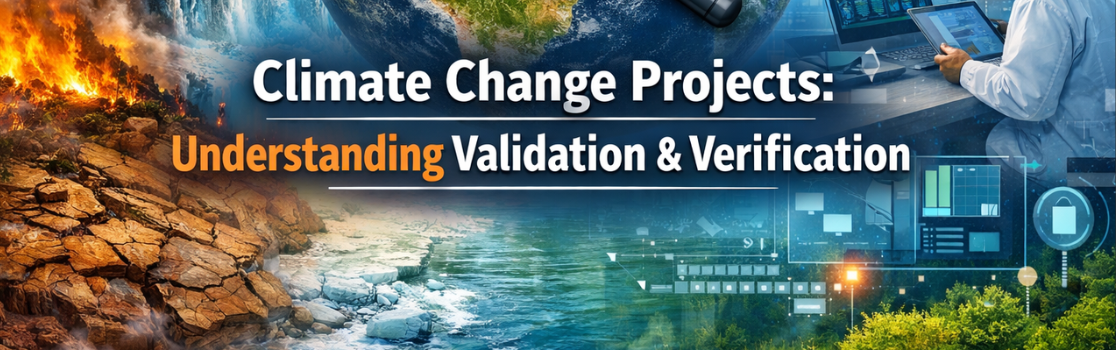
The major climate undertakings have gained all the media attention, such as the solar farms, the carbon goals, and the sustainability roadmaps. They look great in theory, but they all have to be real, measurable, and confirmed by an unbiased third party. In short, if you can’t prove it, it doesn’t count. That crucial step of independent checking, known as validation as well as verification, is what makes climate solutions truly reliable worldwide.
If you’re an organization planning real, on-ground interventions or exploring climate change services, understanding this process is not optional. It’s the silent engine that keeps climate projects transparent, accountable, and actually impactful.
Let’s break it down simply (but accurately):
In the case of validation, we are at the stage of asking, “Maybe this could really work?” Whereas verification is the process of “okay, did you actually do this?” Without these two steps, even the most impressive climate change solutions can fall apart under scrutiny.
In rapidly developing sustainability programs, especially in climate change services in India, this process avoids greenwashing and instills confidence in regulators, investors, and other stakeholders.
There’s a growing wave of climate consciousness, but also growing skepticism. Everyone wants proof, numbers, compliance, and external confirmation. And honestly, that’s fair.
Here’s why validation and verification matter:
Your climate initiative isn’t just a feel-good project; it has a documented impact.
Carbon credits, offsets, and sustainability finance all demand verified performance.
Investors, customers, and regulatory bodies feel far more confident when accredited assessors verify your efforts.
In this era of cautious audiences, rigorous climate change services help organizations stay on the right side of sustainability claims.
The process may seem technical at first glance, but its structure is surprisingly straightforward:
You calculate what emissions or activities would look like without your project. This is your comparison point.
You prepare the methodology, data collection strategy, monitoring plan, stakeholder mapping, basically, everything a validator needs.
Independent auditors review your project documents and determine whether it’s realistically designed for the expected environmental benefits.
Your project runs in real time. Data is tracked, monitored, and recorded systematically.
Verifiers dig into your results, cross-check data, and confirm your climate claims.
After successful verification, your claim becomes official, publishable, and usable for stakeholders or carbon registries.
Organizations achieve the most efficient workflow by ensuring complete documentation and adherence to standards, which are prerequisites for the review by an accredited body like ours.
Even strong climate initiatives can get stuck during validation or verification because of avoidable mistakes:
To avoid these pitfalls, organizations must ensure rigorous adherence to project standards, meticulous data quality, and complete documentation, all essential requirements for a successful validation and verification audit.
If you want to select the best validation/verification partner for a climate project, then you need to keep in consideration the following practical points:
Finally, the right partner would be more than validating a project: they would certainly amplify that project’s credibility across the climate markets.
Whether you’re aiming for carbon neutrality, exploring offsets, or integrating sustainability into operations, high-quality climate change services and structured validation/verification boost your organization’s long-term climate impact. And this is exactly where we, at KBS Certification, see most organizations truly transform, because when validation and verification are done the right way, your climate claims stop being just internal ambitions and start becoming internationally recognized, audit-ready evidence. We help ensure that this shift feels seamless, credible, and aligned with global climate standards.
KBS Certification is an accredited body providing independent assurance services required for climate change projects. Our service is based on experience, not generalized statements. Our teams provide validation and verification for projects utilizing accredited, internationally recognized climate change services.
We validate comprehensive monitoring plans, verify GHG emissions, audit carbon-neutral initiatives, and assess compliance against global standards such as CDM, VCS, and Gold Standard etc. KBS serves organizations implementing reliable climate change projects or specialized climate change services in India through technical depth, sector expertise, and a truly impartial approach.
As a renowned and trusted accredited body in the climate change sector, we make your claims on your climate credible, transparent, and audit-ready; hence, your sustainability journey is impactful and recognized internationally. Connect with us to strengthen your climate commitments with confidence and certified assurance.
Validation confirms your project’s design is scientifically sound, follows approved standards, and can realistically deliver the intended climate benefits.
Verification ensures your climate project’s actual performance is accurate, measurable, and independently confirmed through reliable monitoring and evidence-based reporting.
Organizations implementing emission-reduction, carbon-neutrality, or sustainability projects needing trusted, compliant proof of environmental performance require validation and verification.
Validation partners impartially assess and verify documentation, monitoring procedures, and compliance, thereby confirming that organizations meet global standards and strengthening long-term climate impact credibility.
For detailed training, certification, sustainability, or climate change services–related queries, please  Contact Us

 SIGN IN TO TRAINING ACADEMY